
The First Loop
Cricket has over-monetised the peak and underbuilt the base. The next growth curve starts with participation, where identity, media, data, commerce and community begin.

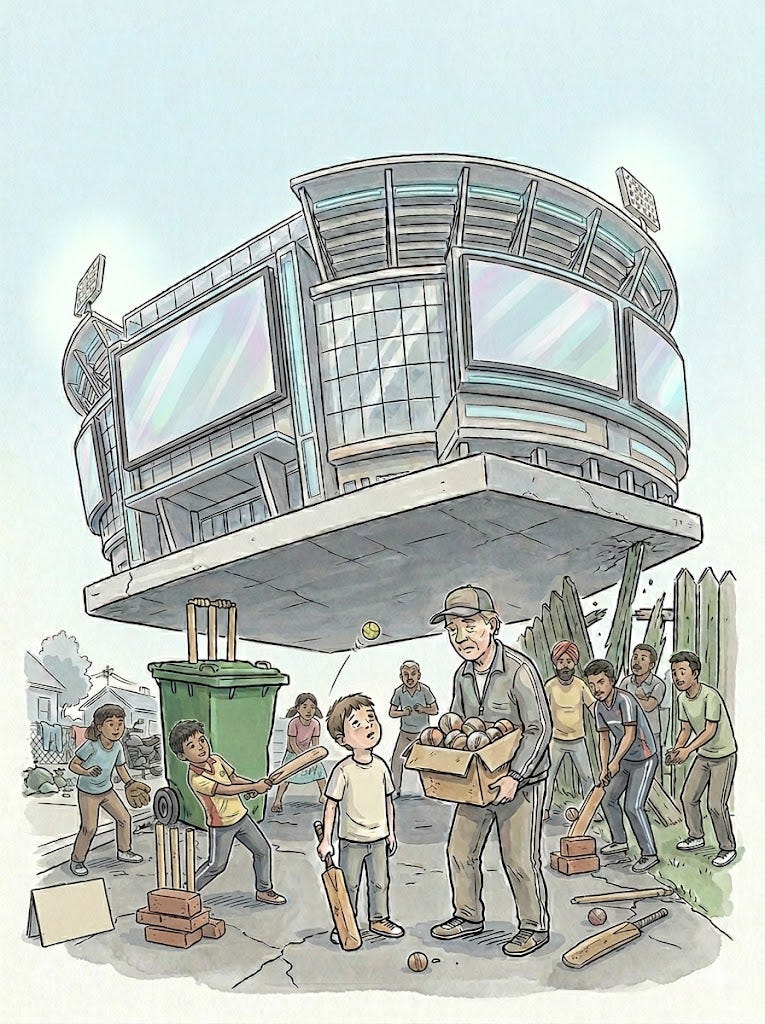
Like a lot of Australian kids, cricket first arrived for me through imitation.
Backyard games. Milo cricket. Copying David Boon shuffling across the crease and Mark Waugh playing through cover off the front foot, even though I had no real idea what either of them was doing. Made-up rules built around fences, bins, walls, siblings, neighbours, and whatever space was available. One hand, one bounce. Six and out. Automatic wicketkeepers. The kind of rules that would horrify administrators and delight children.
(Backyard Cricket UK has been a useful reminder that much of cricket’s emotional architecture still begins in informal play.)
At the time, nobody called that development. Nobody called it anything. It was just play. But somewhere in there, without anyone really designing for it, a sport became part of how I understood the world. The loop that mattered most for my eventual working life in cricket started in a driveway.
That is the loop the sport has spent decades assuming someone else would build.
The Loop I Cannot Unsee
A few weeks ago Andrew Petcash shared a simple flywheel of the sports industry.
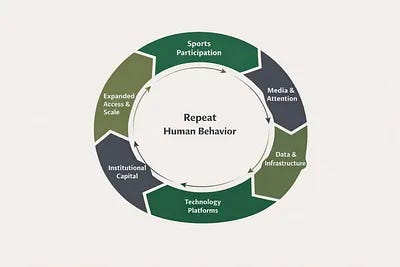
It is a deliberately small diagram for a very large industry, but it reframed my writing, and thesis, for me. Much of what I have written about sits higher up the stack: media, technology, capital, calendars, AI, venues, new formats. All of these are relevant. But before any of it compounds, cricket has to answer a simpler question.
Where does the loop begin?
In most sports, it begins with participation. Cricket, for all its size and noise, has never quite understood how commercially important that is.
Cricket’s Language Problem
For decades, cricket has filed participation in the soft drawer. Development. Grassroots. Pathways. Community. Inclusion. Clinics. School visits. Junior programs. All worthy but almost always treated, in commercial discussions as the work that happens somewhere else, paid for by someone else and after the serious money has been counted.
The serious money is meant to live somewhere else entirely. Broadcast rights. Franchise fees. Sponsorship. World Cups. IPL valuations. Private equity. Data. Betting.
That bucketing is now badly out of date.
The commercial logic for getting this right is not soft. Research from Two Circles puts the stakes plainly: fifty percent of sports fans are made by age fourteen. Those early fans spend more, stay longer, and bring their own children into the sport. That is the compounding return on getting the first experience right. A cricket fan with a playing background spends roughly four times more on the game than one who never played. And over ninety percent of people who start playing cricket do so before they are twelve. After that window closes, it is very difficult to bring someone into the game for the first time.
The global youth sports market was valued at roughly US$37.5 billion in 2022 and is projected to reach close to US$70 billion by 2030. This is now an industry made up of facilities, coaching, registration, payments, equipment, video, data, software, travel, media, and family behaviour. In the United States, youth sport is increasingly treated as a lifecycle, from early physical literacy through club and travel teams, recruitment, digital profiles and elite pathways. Modern sport is treating that layer as commercial infrastructure. Cricket is still treating it as a program. The best youth systems understand that the first loop is not meant to feel commercial to the child.
It starts with physical literacy, joy and the car ride home chatting to dad and mum about that ‘almost moment’ of a catch, six or run out. If the kid wants to come back next week, the system is working. The commercial layer only becomes durable when the human layer is healthy.
Participation is the first commercial layer of the modern sports business. Cricket has treated it like the soft layer after the money.
For investors and operators, the next value pool often forms in the rails beneath the trophy asset everyone already understands. Facilities, coaching, payments, scheduling, video, data, discovery, local formats and parent communication are the infrastructure that makes the visible parts of the sport more valuable.
It is the first loop. And cricket has under-built it almost everywhere it operates.
Over-monetised The Peak, Underbuilt the base
The IPL is one of the great sports business stories of this century. India’s cricket economy is extraordinary. Franchise valuations have soared. Media rights have exploded. The top of the sport has shown what cricket can become when product, scarcity, talent, capital, distribution and cultural meaning all collide in the right place at the right time.
But the IPL is merely the first proof point.
Cricket can clearly generate enormous value at the peak but can it build enough underneath that peak so the sport compounds beyond the same few markets, the same few events, and the same few broadcast cycles?
But even after tripling, the visible developmental line item is still roughly 1:160 of projected surplus.*
Whilst that is not the whole grassroots picture as BCCI also funds domestic cricket, women’s tournaments, player incentives and state associations through other lines, the point remains. Even in cricket’s richest market, it is hard to see exactly how peak-level surplus becomes base-level infrastructure. The money exists. The operating system is harder to find.
India’s situation, of course, is different in kind, not just scale. The informal cricket ecosystem (gully games, tape-ball circuits, neighbourhood tournaments) has produced more players than any structured development programme on earth, and the talent flowing through the IPL is proof it still works - see Vaibhav Suryavanshi!
Each country needs their own model.
Cricket Australia has long been regarded as among the best in the world at participation infrastructure: clear funding flows to state associations, structured club support, programs like Milo Cricket and, now, Cricket Blast that are designed to earn the second interaction. But most participants in entry-level programs do not come back. If that type of churn rate applied to broadcast subscribers or event attendance, it would be a boardroom crisis. Generally, the clubs absorbing this pressure are a smaller group than the headline figures suggest: the top number of clubs by size account for the greatest percentage participation. The heavy lifting is concentrated. The rest are focused on survival.
That model fits the Australian context - smaller population, less of a feverish cricket culture doing the work for free, a competition for kids’ time and attention that is fiercer than almost anywhere else the sport operates.
A child watching a T20 league on television is not the same as a child playing every Saturday. A diaspora family buying tickets to one marquee event in America is not the same as a family entering the weekly rhythm of clubs, camps, school programs and social formats. A viral clip seen in Nigeria is not the same as a local ecosystem.
Cricket has a lot of attention in certain windows. What it lacks in too many places is behaviour between those windows.
That is the difference between a moment and a market.
Raj
Raj, our protagonist from earlier articles, grew up in Mumbai in the mid-2000s. He learned cricket the way most Indian kids did then. Gully games against older boys. Tape-ball tournaments on Sundays. A school side that took him as far as inter-school zonals. A local club. An age-group state side. A trial at the NCA. By the time he was 19, three IPL franchises had a file on him.
Raj had a career. He played international cricket for a few years. He earned well through the franchise circuit across two continents. He retired at 31, set financially for life, and walked away from the game faster than most expected. Cricket monetised Raj efficiently.
What cricket did not do was reinvest in the layer that produced him.
The streets he played on still produce cricketers, but less of that layer feels intentionally protected, measured or reinvested in. The Sunday tape-ball tournament still runs, but the volunteer who organised it is older and there is nobody behind him. The local club exists on paper. The school no longer has a regular fixture list. The age-group state pipeline is intact but is being asked to do the work that the layers below it used to do. The system did not break. It just stopped reinforcing itself.
Raj is real enough as a composite to be true of dozens of subcontinental careers. He is the over-monetised peak in one person, and evidence of the underbuilt base underneath it.
Maya
Now think of a different kid, in a different city.
Maya is twelve, lives in Toronto, has played softball since she was seven. Cricket arrived through a TikTok clip last winter, then a school assembly run by a local cricket organisation. Her school does not have a club. Her parents have no relationship to the sport. Her PE teacher had not seen a game until eight months ago.
Maya is not anti-cricket. She is pre-cricket. She has no inherited reason to care, which means the product has to earn the second interaction.
What she did find was a six-over format running once a week: soft ball in the gym, scored on a phone app, four players a side, every player bats, every player bowls. No pads. No helmets. No five-day cultural prerequisites. A first experience worth repeating.
That is not a watered-down version of cricket. That is product design.
Whether she becomes a player, a fan, both, or neither will be decided by whether her first interaction connects to a second one. A WhatsApp group. A summer holiday clinic. A clip of her hitting a four sent to her grandparents. A reason to come back.
This is what the ICC’s Criiio programme is reaching for at scale -- “anywhere, anytime, anyone,” with a kids hub, cricket festivals, and Criiio4Good initiatives running in markets from Bhutan to Brazil. The format gets Maya in the room. The system is what makes her stay. Right now, in most cities where she lives, there is still not enough of either.
This is a system design problem that is solvable.
Leagues Capture Attention. The First Loop Creates Habit.
This is not an anti-league argument. Leagues and franchises generate drama, scarcity, heroes, tribalism and valuation benchmarks. They give investors something to buy, broadcasters something to package, sponsors something to attach to, and fans something to organise around.
But leagues alone do not build a sport. They capture attention. They do not automatically create habit.
The chain is straightforward enough. This is Petcash’s wheel turning at scale.
In cricket, that loop is broken in too many places. Either there is no first interaction worth repeating - Maya, in most emerging markets - or there is a first interaction but no system underneath it to reinvest in the layer that produced the talent. Like Raj, in too many subcontinental gully economies.
Both failures point at the same gap. The first loop.
The GameChanger Lesson - And The Let Kids Play Act
Once you see participation as the first loop, the technology question changes. The real challenge is simple: how do we make the second interaction easier? Easier for the kid. Easier for the parent. Easier for the coach. Easier for the club. Easier for the grandparent watching from another city.
This is where the United States youth sports ecosystem becomes instructive: a model to study carefully, especially for what it built and what it broke.
Let’s start with GameChanger, which was at the PEAK Conference in Las Vegas, where I recently spent time discussing the youth sports stack.
Its genius was not that it made youth baseball more professional. It made ordinary participation easier to remember, follow and share. A parent could score a game. A grandparent could follow remotely. A player could see their stats. A coach could manage the team. The local game became a small media product.
TeamSnap, also at PEAK, solved a different layer: family logistics. Registration, scheduling, payments, team messages, who is bringing oranges, who is stuck in traffic. Not glamorous. Essential.
MOJO went at the volunteer coaching problem. Most junior sport is carried by parents who care deeply and have no idea what session to run on Thursday. Give them curriculum, video and progression, and the first experience improves.
Pixellot, Veo and Hudl push the loop further into automated capture and highlights. The point here is memory, feedback and connection.
Together, these tools show what happens when participation is treated as infrastructure rather than charity.
Cricket has versions of these pieces. PlayHQ has strengthened club administration in Australia. Out of India, CricHeroes has built a massive scoring and community layer. SportVot is turning lower-tier cricket into watchable media. Cricket Unlocked is working on market-specific onboarding and participation design.
The problem is that they do not yet combine into one loop. At its best, the American youth sports stack points toward a more connected experience: a parent registers a child, receives the schedule, scores the game, shares the highlight, follows the stats and helps a volunteer coach run a better session. The tools may still be separate, but the user journey is increasingly legible.
Cricket’s tools, by contrast, mostly live in separate silos and are separated by geography, federation, sponsor relationship and software vendor. The components exist. The operating system does not.
It is one problem with five surfaces: discovery, operations, content, coaching and retention.
But here is what the US model also produced. In May 2026, US senators and representatives introduced the Let Kids Play Act - federal legislation targeting private equity ownership of youth sports teams, leagues, and facilities. The bill is reacting to junk fees, lock-in contracts, stay-to-play travel requirements, and roll-up consolidation that turns local clubs into profit centres. Some competitive pathways now exceed US$5,000 per child per year, while average family spend has risen sharply since 2019. Overall participation is still rising, but access splits sharply by income.
The bill’s introduction is an indictment of an unchecked capital stack that, left to optimise for extraction rather than access, eventually prices out the kids it was supposed to serve.
The lesson for cricket is not to avoid private capital in participation. It is to be deliberate about what that capital optimises for. The US model is worth studying. Its downsides are worth designing against from the start.
Cricket has the advantage of coming to this moment with clear sight of what happens when access gets traded for margin. That is not a small advantage.
As I have argued before, Cricket does not need to copy other sports blindly. It needs to study what they built, understand what they broke, and design a better version for the game’s own geography, culture and economics.
Participation Is a Product Design Problem
Cricket’s mistake has often been to assume that the purest version of the game should be the entry point. There is a second, less obvious mistake layered underneath it: assuming that participation is essentially about progression.
Most kids who show up to community cricket are not there to make it. They are there to belong, to move, to compete, to be part of something. A smaller group - a handful in any squad - genuinely want to improve, advance, reach the next level. The pathway is designed almost entirely for them. For everyone else, cricket offers an increasingly narrowing corridor: harder balls, heavier pads, a more serious competition structure that requires graduating to the “proper” version of the game. That transition is the point where most kids and parents leave.
Why can’t someone play tape-ball cricket at five and still be playing tape-ball cricket at thirty-five? The pathway does not have to go up and to the right. Designing only for progression designs out the majority.
The history of the sport’s best participation moments suggests a better approach is possible.
Australia gave cricket the club-and-school lesson through Milo Cricket, now Cricket Blast. The subcontinent gives it the informal-play lesson: gully cricket, tape-ball, improvised formats that have produced more cricketers than any academy system on earth. The Caribbean gives it the cultural-meaning lesson. England gives it the legacy-institution lesson, for better and worse.
But Australia, arguably the gold standard in participation, is also living through the next chapter in real time. Participation is shifting beyond traditional clubs into parks, streets and backyards, with the Australian Sports Commission’s recent work recognising the need to reduce barriers around cost, time and rigid scheduling. The nostalgia for Backyard cricket is nice, but it may be a clue to what the next participation model actually looks like.
Cricket’s opportunity is not to copy any one of these models. It is to build a better hybrid. The format designed for a gully in Mumbai will not work for a school gym in Toronto. The game Pakistan already loves cannot be airdropped into Los Angeles, California and expected to land.
This is where the hybrid approach becomes interesting. Softball mechanics. Familiar field geometry. A bat-and-ball crossover that does not ask a twelve-year-old in Toronto to abandon what she already understands before she has a reason to care. The schools version of that idea - a six-over game that incorporates elements of softball and rounders, playable in a gym, scoreable on a phone - does not have to be a gimmick. It can be the entry point the market actually needs. And if you can send a clip of Maya hitting a boundary to her grandparents or her coach in the next suburb, you have started a loop.
Format design, in other words, is strategy. It determines who gets invited in.
It also determines who gets designed for from the start. New Zealand Cricket is a useful case because it treats entry-level participation as design rather than outreach. Smash Play has been adopted by around 68% of New Zealand clubs. Girls Smash gives girls a specific entry-level format. In the 2021/22 season, about 60% of the 3,000 participants in the Yeah! Girls programme were new to cricket. These are real attempts to make cricket easier to try, easier to enjoy and easier to return to. The lesson here is not “do more for girls.” It is that participation design changes who gets invited into the sport.
Pickleball’s recent partnership with Boys & Girls Clubs of America makes the same argument from a different sport. USA Pickleball has grown to 24 million players, and its Boys & Girls Clubs partnership shows how seriously it is treating distribution infrastructure: starter kits, structured programming, and court installations in communities that had never had access to the sport.
The NFL’s approach to growing its game in Australia makes the same argument from a different angle. They are using next season’s NFL game as a marquee event, but the real work is underneath it: school programs, flag football competitions, and equipment kits landing in PE departments. Here, the base is being built deliberately before the peak arrives. The fandom is being cultivated, not assumed.
Some of the most interesting work may come from the edges rather than the centre. Namibia has integrated mini-cricket into school PE across many of its regions. Bhutan has used tennis-ball formats to reach thousands of girls who had no previous access. Vanuatu has blended remote coaching with the realities of seasonal worker communities. These are early examples rather than scaled platforms. But they point at the same conclusion: the first loop has to be designed for the lives people actually live, rather than for the sport’s preferred version of itself.
The First Loop
The first loop is not theoretical. It is already being built, just unevenly.
Discovery. Format design. Registration. Coaching. Scoring. Video. Communication. Data. Community. Retention.
The pieces exist. The missing ingredient is institutional intent.
Think about which sports organisations are actually designed to think generationally. The IOC books venues twelve years out. Its four-year cycles build in a kind of long-term accountability that almost no other governing body in sport has. This is a huge tailwind for cricket in my opinion.
Almost everywhere else, management tenures average three to five years and KPIs are annual. Nobody is structurally accountable for the health of cricket’s fan base in 2035. By the time a generation is lost, the decision-makers have moved on.
Cricket’s decision-makers have spent decades treating participation as something adjacent to the commercial engine. The next decade may punish that mistake. Because the organisation that owns the first interaction, the second interaction and the reason to come back may end up owning something more valuable than a rights window. It may own the relationship.
I probably understood the first loop before I had the language for it. So did Maya. So did Raj, in his way.
That is what the participation layer does at its best. It turns a sport from something you watch into something that belongs to you. From a product into a habit. From a moment into a market.
Play. Share. Improve. Belong. Return.
That is the behaviour cricket needs more of. Everything else in the flywheel depends on it.
Cricket already has the peak: IPL, stars, major events, celebrity investors, tradition and cultural weight in places no commercial logic on its own can explain.
What it does not yet have, in most of the places it operates, is the first loop.
The first loop is the one cricket spent decades assuming someone else would build.
Someone else hasn’t.
Now the builders are here and they are building something interesting.
The question is whether cricket backs them before the next generation builds its sporting identity somewhere else.
The next piece goes deeper into the youth sports operating stack like PlayHQ, TeamSnap, SportVot, automated capture, private academies, facility networks, affordability, and what a cricket-native version could look like. Raj and Maya will still be there, because they are the two ends of the same argument.
*Footnote
This comparison is not intended as a complete measure of BCCI’s grassroots investment. The ₹42 crore figure refers to reported expenditure on India A and junior/developmental programmes, not total development spend. BCCI also distributes significant funds to state associations and supports domestic competitions through separate budget lines. Some of that money almost certainly reaches grassroots cricket, facilities, coaching and pathway activity. The issue is transparency: public reporting does not clearly show how much of the surplus ultimately reaches the base of the game, or how effectively it compounds into long-term participation infrastructure.